


What a Difference Some Lightning Makes: A Look at the F-150 and Its Lightning Counterpart
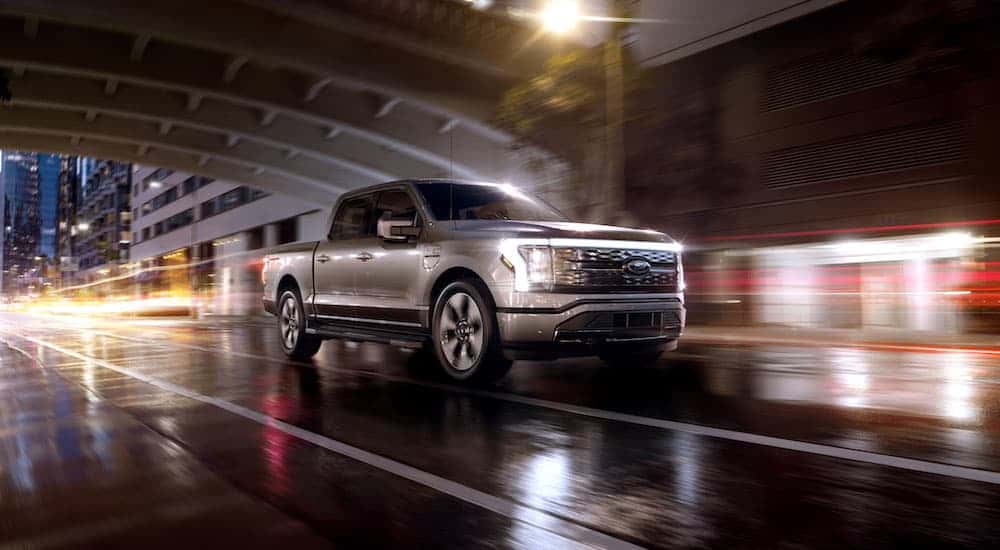
At a casual glance, one might look at the Ford F-150 and the F-150 Lightning and think they have a lot in common. To be fair, they do have quite a few things in common: they’re both full-size trucks that ostensibly look similar, they both offer impressive power and performance with robust towing and payload capacities, and they both have exceptional tech features and options like the Ford Pro Power Onboard system. Beyond these surface-level similarities, however, there are some massive differences between them, which you should keep in mind before looking for a Ford F-150 for sale at your favorite dealership.
The most significant difference between them, and the one that many other differences cascade from, is the fact that the standard Ford F-150 is a conventional vehicle with an internal combustion engine (ICE)—though a hybrid model is available—while the F-150 Lightning is a battery electric vehicle (BEV). This is at the forefront of the differences between these two trucks, and if you remember nothing else about them, then this is the one thing you should know. From there, you’ll find a wide range of other distinctions, such as the horsepower and torque they can offer, how much towing they can handle, your options for cab size and bed length, and more. Let’s take a look at some of these differences in greater detail to really get a sense of what these two trucks bring to the road.
The Big One: Engines
We’re not going to bury the lede here: the biggest, and arguably most important, difference between these two trucks is their engine and powertrain. The Ford F-150 is still a conventional ICE pickup; it’s engineered with incredible precision and modern technology to deliver remarkable performance, but at the end of the day, it’s still a gas-powered truck. That being said, there are five different engines available for the standard F-150, including a starting 3.3L V6 with 290 hp and a 5.0L V8 with 400 hp and 410 lb-ft of torque. If you want the highest performance with the F-150, then there’s an available 3.5L PowerBoost Turbo V6 Hybrid engine that delivers 430 hp and 570 lb-ft of torque.
Looking at the Ford F-150 Lightning, however, everything is different because the Lightning is a BEV with a battery system and electric motors. There’s no standard engine here with cylinders and all that—this is the future of the auto industry, and it has the power to back that up. You have two different battery options for the F-150 Lightning: a Standard Range model that delivers 452 hp and an Extended Range version with 580 hp. You can immediately see just how much more power the Lightning offers, but we haven’t even mentioned that both options deliver 775 lb-ft of torque, which blows away what the standard F-150 can do.
We should also point out that the Ford F-150 is available with either Two-Wheel Drive (2WD) or Four-Wheel Drive (4×4), depending on the model and options you choose. The F-150 Lightning, on the other hand, comes with two motors—one on each axle—regardless of which battery you choose, which makes every Lightning an All-Wheel Drive (AWD) model. Some other BEVs out there are available with either one or two motors, giving you either 2WD or AWD, so seeing AWD as the standard option on the F-150 Lightning is a beautiful thing.
Fuel Efficiency vs. Electric Range
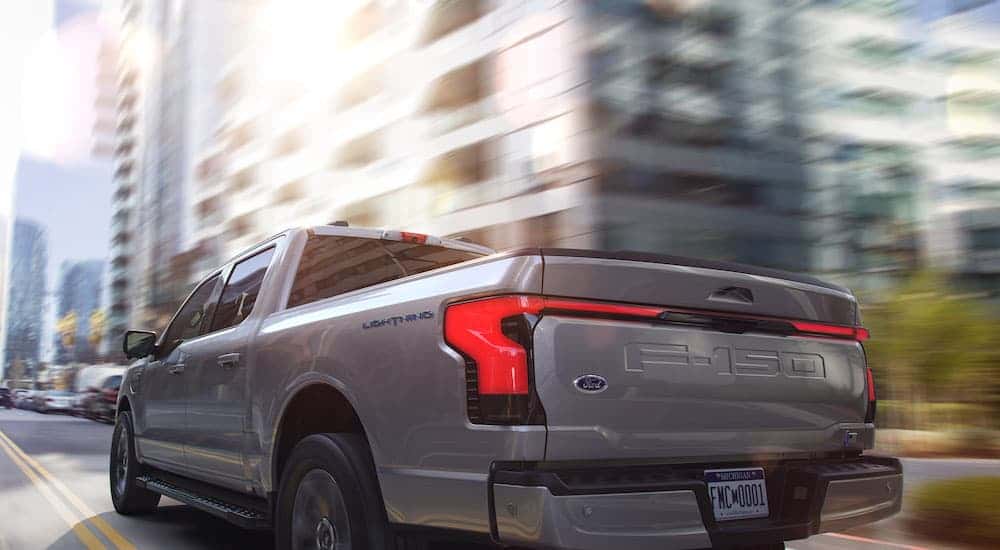
Along with differences in power due to ICE vs. BEV design, you also have to consider the range of your truck in different ways depending on which of these you choose. With the standard Ford F-150, you’re looking at typical fuel efficiency, which depends primarily on the engine you choose, and most of the options for the F-150 give it similar gas mileage. The standard engine gets an estimated 19 MPG in the city, 24 MPG on the highway, and 21 MPG of combined fuel efficiency; while the available Hybrid engine boosts those numbers up to an estimated 25 MPG for the city, highway, and combined fuel efficiencies.
With the Ford F-150 Lightning, you’re dealing with a battery that needs to be charged rather than an engine that requires gas. As we mentioned above, you have two battery options available, and the range you get from a full charge depends on which one you choose. As their names suggest, they offer different ranges: the Standard Range battery gets an estimated 240 miles from a full charge, while an Extended Range model can go up to 320 miles with a full charge. If you’re in a situation where you can easily charge your truck at home overnight, then skipping the gas pump with the F-150 Lightning can make your life much more convenient.
Towing and Payload Differences
As we’ve seen so far, the all-electric Ford F-150 Lightning comes out on top in terms of the power it delivers and how well it lets you leave the gas pump behind. One area where there is still some room for improvement with BEV trucks is the capability they can offer for towing and payload. More weight reduces your range with a BEV, just as it reduces fuel economy with a conventional ICE truck. The development of electric pickups has required careful balancing of power and capability, while the standard F-150 has decades of improvements behind it.
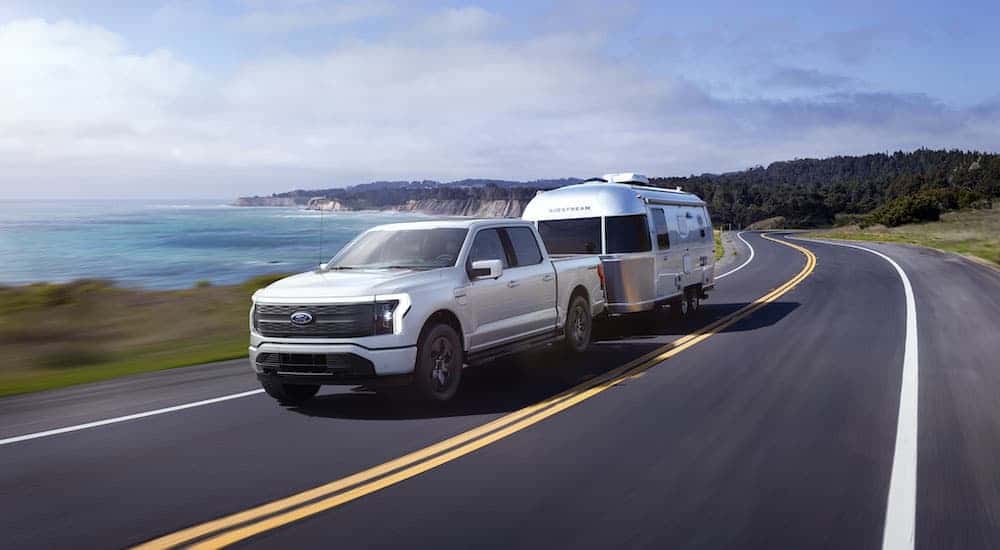
The Standard Range version of the F-150 Lightning can handle up to 7,700 lbs of towing capacity and up to 2,000 lbs of payload. Looking at the Extended Range version, towing improves to 10,000 lbs, but payload goes down to 1,850 lbs. With the conventional F-150 and its standard engine, you can get 8,200 lbs of towing capacity and 1,985 lbs of payload. Where the F-150 Lightning really can’t keep up is when you start looking at some of the engines available for the ICE version: the 3.5L EcoBoost Turbo V6, for example, gives the F-150 up to 14,000 lbs of towing capacity and up to 3,250 lbs of maximum payload. That 4,000-lb difference can certainly matter if you’re looking to push the limits of what your truck can tow; it’s one reason some people are sticking with the standard F-150 over the Lightning for now.
Configuration Options and Cargo Space
Finally, we should consider the kinds of options you have for the configuration of your truck, as the design of the conventional F-150 has much more freedom to it. If you’re interested in the all-electric F-150 Lightning, then you have just one option: a SuperCrew cab paired with a 5.5-foot bed, which gives you 52.8 cu.ft. of cargo volume. We should mention the lack of an engine means the Lightning also has a front trunk—or frunk—with an additional 14.1 cu.ft. of cargo space for you to utilize.
By comparison, with the standard Ford F-150, you have much more freedom to get just what you want in your truck. The F-150 has three different cab sizes available: Regular, SuperCab, and SuperCrew, letting you get the right interior layout for what you need. You also have three different bed lengths offered on the standard F-150: the same 5.5-foot bed as the Lightning, along with a 6.5-foot bed that offers 62.3 cu.ft. of cargo volume, or an 8-foot bed that gives you 77.4 cu.ft. of total cargo space to utilize. This may or may not matter to you, depending on what you want, but it’s worth keeping in mind.
What Does This All Mean for You?
As you can see, there are significant differences between these two trucks, even though they’re both called the “F-150,” and they do have some design and engineering details in common. The specs and features between them can be substantially different, so you must look at all of your options before deciding on your next truck. This is why it’s vital that you work with a dealership that understands the Ford lineup inside and out, with people who can help you explore these different models and point out key differences between them. Come visit us at The Faricy Boys Ford to learn more about both the standard Ford F-150 and the F-150 Lightning; we’ll help you choose the right truck with everything you need.
0 comment(s) so far on What a Difference Some Lightning Makes: A Look at the F-150 and Its Lightning Counterpart